
Alex Johnson recently published an excellent article on the forces shaping financial services in 2026. He paired industry predictions with the kinds of resolutions banks and fintechs will need to make in response.
The real insight wasn’t the forecasts themselves (though they were all highly relevant), but the discipline of tying resolutions to realities, and then building executable strategies to support them.
Viewing his list through the lens of a typical community bank or credit union operating with constrained budgets and staffing, I thought:
Which of these trends are most likely to matter in 2026, and are too dangerous to ignore?
I narrowed his ten trends to three that I think smaller institutions should be prioritizing now, using the filters:
- Does it have a high probability of affecting business in 2026?
- Is it addressable with limited resources?
- Is there a serious downside if a response to the trend is delayed?
Here’s my short list of concerns that should be addressed in the next year:
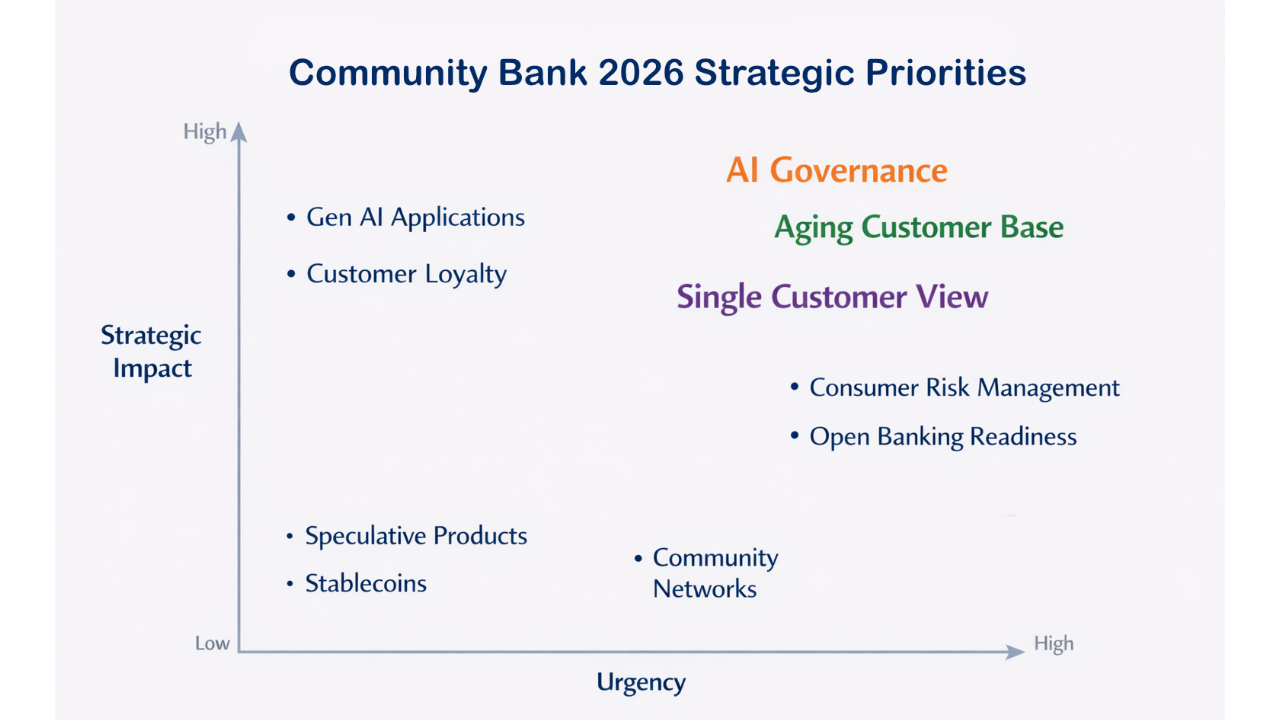
1️ AI adoption and governance
This one is unavoidable. Banks need board-approved AI policies, defined governance structures, and clarity on where AI already exists inside vendor platforms.
Just as important: identifying priority use cases and hardening the data foundations that AI depends on so experimentation happens safely, not recklessly.
AI strategy isn’t a tech project anymore. It’s enterprise risk management.
2️ A true single view of the customer (and household)
Growth today doesn’t come from pushing products, but rather from deepening relationships.
That requires centralizing customer data in a modern warehouse so banks can:
- price relationships holistically
- understand household dynamics
- personalize offers
- improve fraud detection
- surface attrition risk
Without this foundation, every growth initiative becomes harder and more expensive.
3️ Serving and protecting an aging customer base
Demographics and wealth transfer aren’t abstract trends anymore. Banks face both enormous opportunity and rising risk as assets transfer across generations. And fraudsters increasingly target older customers.
Thoughtful product design, monitoring, education, and family-aware account structures can protect customers and preserve relationships as wealth moves to heirs.
It’s both good business and good stewardship.
The accompanying urgency-versus-impact matrix image shows my subjective placement of the challenges Alex noted in his article. Which of these trends feels the most urgent for your institution right now?
